
Published 2026-11-14 · DIYCarPlay Engineering Team · 17 min read
How Many CarPlay Platform Codes a Customer Enquiry Still Leaves Open: The 120 Order Lines That Need One More Question
A wholesale CarPlay order is written from a customer enquiry, and a customer enquiry carries three things: a badge, a model name and a model year. Those three settle the platform code for most cars in this catalogue. The catalogue holds 39 platform codes over 76 code-and-model-line combinations, covering 300+ vehicle models and series from model years 2006 to 2025, and 50 model names sit under more than one platform code. Written out one name and one year at a time, those lines cover 1,033 distinct model-and-year combinations. 913 of them are covered by exactly one platform code. The other 120 are covered by two, and those 120 are what a buyer has to see before a pallet is packed.
Reading a head unit is a solved problem with a long list of methods, and this catalogue has worked through most of them. This one works from the other end of the process. It measures what is left over once brand, model and year have been applied, sorts that residue into three kinds, and states which single extra fact closes each kind. The measurement is worth having because the residue is not spread evenly across the catalogue. It concentrates in twelve code pairs, it concentrates in a few marques, and for one group of model names the model year carries no information at all.
What brand, model and year settle on their own
Every fitment line in the catalogue names the cars a platform code covers and the model years that line covers. A buyer reading a customer list does the same thing in reverse: a name and a year go in, and the code comes out. The line answers that only when the line actually covers that name in that year, and a name can be covered by two codes at once when a marque used two head units across the same model years.
Written out one name and one year at a time, the 76 lines cover 1,033 combinations. A line naming six cars over a six-year window contributes thirty-six of them; a line naming one car over one year contributes one. Open-ended year ranges are counted through to 2025, the last year the catalogue covers. Each combination is then checked against the codes that cover it, and 913 of them come back with a single code. The 120 that come back with two are the open cases, and they are listed below by the pair of codes responsible.
| The two codes that both cover the car | Model names involved | Open cases | Cumulative share of open cases |
|---|---|---|---|
| JR-2 (Harman 8") + JR-3 (Harman 10.25") | Discovery, Range Rover, F-Pace, XF, XJ, F-Type | 36 | 30.0% |
| NI-1 + NI-2 | QX50, QX60, QX70, QX80, Patrol | 30 | 55.0% |
| MMI 2G + MMI 3G | A1, Q3, Q5 | 21 | 72.5% |
| CDR 3.0 + PCM 3.1 | 911 | 7 | 78.3% |
| NTG4.0 + NTG4.5/4.7/5.0 | A, B, C, E, ML, GL | 6 | 83.3% |
| VO-2 + VO-3 | S60, S90, V60, XC60 | 4 | 86.7% |
| RO-CIC + RO-NBT | Phantom | 4 | 90.0% |
| CIC + NBT | 3 Series, 7 Series, X3 | 3 | 92.5% |
| EVO + NBT | MINI | 3 | 95.0% |
| HU6 + NTG4.5/4.7/5.0 | A, CLA, GLA | 3 | 97.5% |
| LE-1 + LE-2 | IS, CT | 2 | 99.2% |
| RO-EVO + RO-NBT | Phantom | 1 | 100.0% |
Three pairs hold 87 of the 120 open cases, or 72.5% of the total, and the largest pair on its own holds 36. A buyer who knows the six Land Rover and Jaguar nameplates, the five Nissan and Infiniti nameplates and the three Audi nameplates has covered almost three quarters of everything that can go wrong from a customer list. That is a short list to hold, and it is a short list to write onto an order desk checklist.
Three kinds of open case
The 120 open cases are not all the same kind of problem, and the difference decides what a buyer has to ask for. Sorting them by how far the model year actually narrows them produces three groups.
The first group is the sharpest. For 10 model names the two codes carry exactly the same model-year window, so the year on the enquiry removes nothing at all. The MINI is listed under the NBT and EVO codes for the same 2014 to 2016 window. The A1 and the Q3 sit under the MMI 2G and MMI 3G codes for the same 2012 to 2018 window. The 911 sits under the CDR 3.0 and PCM 3.1 codes for the same 2010 to 2016 window. The six Land Rover and Jaguar nameplates sit under the JR-2 and JR-3 codes for the same 2016 to 2021 window. Those 10 model names whose year windows are identical under two codes account for 60 of the 120 open cases, which is half of the total. A buyer asking those customers for the model year has asked for nothing.
The second group overlaps in a single model year. Five pairs work this way: the Mercedes-Benz A, B, C, E, ML and GL Class names overlap between the NTG4.0 and NTG4.5/4.7/5.0 codes in 2013 alone; the Volvo S60, S90, V60 and XC60 overlap between the VO-2 and VO-3 codes in 2018 alone; the Mercedes-Benz A, CLA and GLA overlap between the NTG4.5/4.7/5.0 and HU6 codes in 2019 alone; the Lexus IS and CT overlap between the LE-1 and LE-2 codes in 2015 alone; and the Rolls-Royce Phantom overlaps between the RO-EVO and RO-NBT codes in 2015 alone. These 16 cases are narrow, and the year narrows them to a single year rather than removing them. A 2013 Mercedes-Benz C-Class is not settled by being a 2013 car; it is narrowed to the year in which the handover happened, and the build date inside that year is what decides it.
The third group overlaps across a band of years. Four pairs sit here, and one of them is larger than the other three combined: the Nissan and Infiniti QX50, QX60, QX70, QX80 and Patrol names overlap between the NI-1 and NI-2 codes from 2013 to 2018, which is 30 open cases; the Audi Q5 overlaps between the MMI 2G and MMI 3G codes from 2012 to 2018, which is 7; the Rolls-Royce Phantom overlaps between the RO-CIC and RO-NBT codes from 2009 to 2012, which is 4; and the BMW 3 Series, 7 Series and X3 overlap between the CIC and NBT codes from 2012 to 2013, which is 3. Those 44 cases are the ones where the model year does real work and still does not finish the job.
| Kind of open case | Scope | Open cases | What the model year does | What closes it |
|---|---|---|---|---|
| Identical year window under both codes | 10 model names across four code pairs | 60 | Nothing | The head unit itself |
| Overlap in one model year only | 5 code pairs, 16 model-and-year combinations | 16 | Narrows to one year | The build date |
| Overlap across a band of years | 10 model names across four code pairs | 44 | Narrows, does not settle | The build date with the model year |
The MMI 2G and MMI 3G pair appears in two of the three groups, and that is not a miscount. The A1 and the Q3 overlap across the whole 2012 to 2018 window, while the Q5 overlaps over a narrower band because it is listed twice under the MMI 3G code with two different year ranges. The guide to how wide a platform code covers works through how the fitment sheet records that, and it is the reason a name can sit in one group while the code pair it belongs to reaches into another.
Which marques carry the risk
The same measurement taken per marque group shows something that a count of codes cannot. The marque with the most open cases is not the marque with the most cars and it is not the marque with the most codes. Land Rover and Jaguar run three codes across 60 model-and-year combinations, and 36 of those combinations are open, which is 60.0% of everything the marque carries. Nissan and Infiniti run two codes across 65 combinations and leave 30 open, which is 46.2%. Audi runs three codes across 120 combinations and leaves 21 open, which is 17.5%.
Below that the rates fall away fast, and below a certain point the marque stops being a risk at all. BMW carries the largest number of combinations in the catalogue at 187, and 6 of them are open. Mercedes-Benz follows at 166, with 9 open. Ten of the nineteen brand groups have no open case whatsoever: a customer list naming a Bentley, a Lamborghini, an Aston Martin, a Toyota, a Maserati, an Alfa Romeo, a Ferrari, a McLaren, a Volkswagen or a Honda is settled by the badge, the model name and the model year, with no head unit check required before the unit ships.
| Marque group | Platform codes | Model-and-year combinations | Still open | Open rate |
|---|---|---|---|---|
| Land Rover / Jaguar | 3 | 60 | 36 | 60.0% |
| Nissan / Infiniti | 2 | 65 | 30 | 46.2% |
| Audi | 3 | 120 | 21 | 17.5% |
| Rolls-Royce | 3 | 35 | 5 | 14.3% |
| Porsche | 3 | 75 | 7 | 9.3% |
| Volvo | 3 | 71 | 4 | 5.6% |
| Mercedes-Benz | 3 | 166 | 9 | 5.4% |
| Lexus | 2 | 46 | 2 | 4.3% |
| BMW | 3 | 187 | 6 | 3.2% |
| Bentley | 2 | 14 | 0 | 0.0% |
| Lamborghini | 2 | 11 | 0 | 0.0% |
| Aston Martin | 2 | 7 | 0 | 0.0% |
| Toyota | 2 | 40 | 0 | 0.0% |
| Maserati | 1 | 6 | 0 | 0.0% |
| Alfa Romeo | 1 | 6 | 0 | 0.0% |
| Ferrari | 1 | 24 | 0 | 0.0% |
| McLaren | 1 | 48 | 0 | 0.0% |
| Volkswagen | 1 | 42 | 0 | 0.0% |
| Honda | 1 | 10 | 0 | 0.0% |
That ranking is the part a distributor can act on directly. A workshop that fits one car a week does not need a head unit check on every car that arrives. It needs one on the Land Rover and Jaguar jobs, one on the Nissan and Infiniti jobs, and one on the Audi jobs, and it can leave the other sixteen brand groups to the model year. The Land Rover and Jaguar module index and the Nissan and Infiniti module index carry the code list for the two marques where the check earns its cost.
What the extra question has to be
Because the three kinds need different answers, an order desk cannot use one question for all of them. What each kind requires follows directly from what the model year does to it.
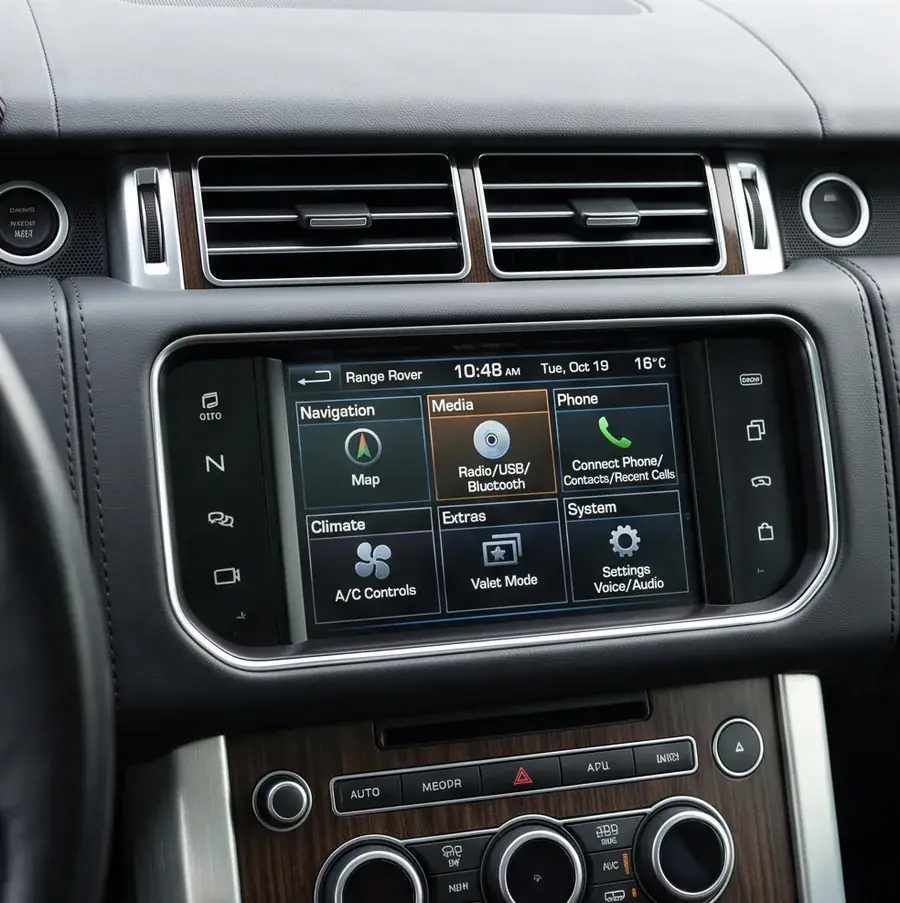
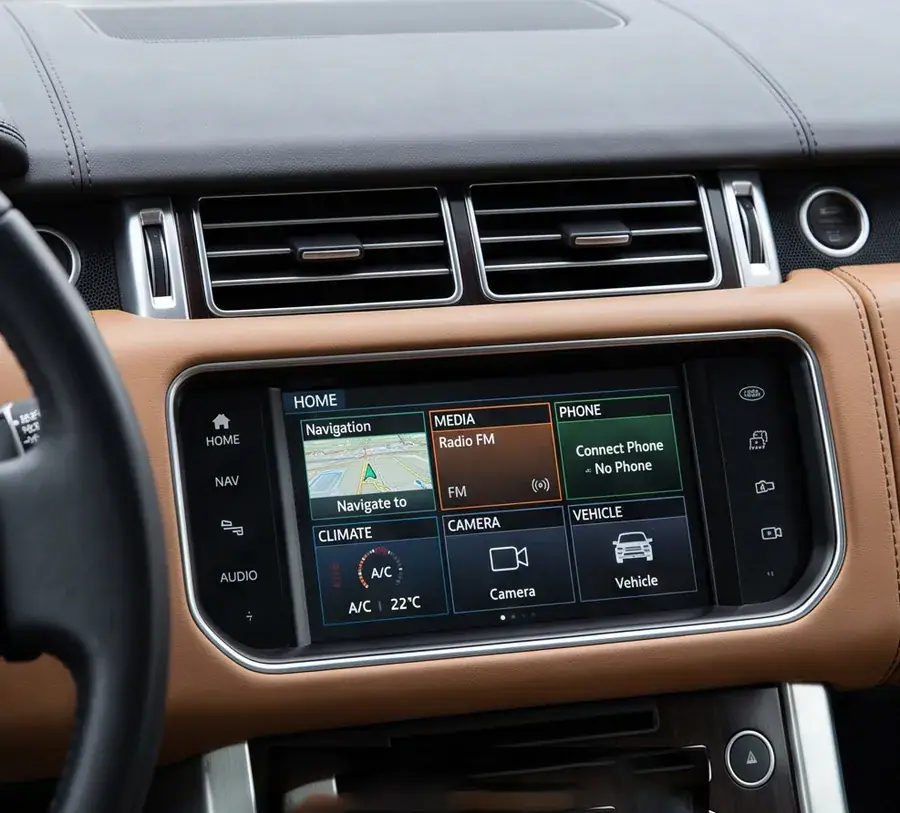
For the sixty cases where the year carries no information, the question has to be about the car rather than about the paperwork, and the answer is different for each of the four code pairs involved. For the Land Rover and Jaguar pair it is the display: the smaller InControl Touch panel and the larger InControl Touch Pro widescreen were fitted across the same 2016 to 2021 model years, and a photograph of the centre stack settles it. For the Audi A1 and Q3 it is the head unit revision behind the display. For the Porsche 911 it is whether the car carries the base radio or the navigation head unit. For the MINI it is the iDrive generation fitted, because the F56 nameplate appears under the NBT and EVO codes with the same year window on both lines. All four of those are read from the car, and the guide to the badge on the screen and what it cannot settle sets out why the marque badge settles none of them.
For the sixteen cases that narrow to a single year, the year on the enquiry is worth keeping and the build date is what is missing. A 2018 Volvo S60 is narrowed to the 2018 production year and no further, because that year is the overlap between the two Sensus revisions, and a car registered in 2018 may have been built to either specification depending on the month it left the factory. The build plate carries the month. The same applies to the 2013 Mercedes-Benz handover, the 2019 Mercedes-Benz handover, the 2015 Lexus handover and the 2015 Rolls-Royce handover.
For the forty-four cases that overlap across a band of years, the model year does real work and the missing piece is again the build date. The Nissan and Infiniti QX50, QX60, QX70, QX80 and Patrol names overlap between the NI-1 and NI-2 codes from 2013 to 2018, so a customer list naming those nameplates and that span narrows the code to two possibilities rather than one, and the revision fitted behind the display decides between them.
Two rules follow for the order line itself. A line should never carry a bare year and a bare badge, because those are the two fields that fail together in all three kinds. Where the marque group has no open case at all, the badge, the model name and the model year are the complete key and no further field is needed. Where the marque group does have open cases, the line should carry the platform code the workshop is expected to fit and the fact that settles it, so the workshop is not left to infer a code from a customer list that was never complete. The vehicle fitment finder walks the same fitment data by model, by nameplate and by platform code, and the guide to the chassis designation as the finer fitment key covers the cases where a chassis code settles what the model year cannot.
Where this sits against the eleven routes already published
Reading a platform code off a car is a solved problem with a long list of methods, and this catalogue has worked through most of them: the shape of the centre display, the string on the version screen, the build plate and the parts catalogue, the model year, a diagnostic read on the vehicle network, a code that carries more than one generation, the factory CarPlay date, the family a code's name belongs to, the chassis designation stamped into the body, the coverage width of a code, and the marque's own badge on the screen. Apple's own CarPlay model list is published in the same three fields a customer enquiry arrives in, which is why those three fields are where a fitment question starts.
Each of the eleven is a way to obtain the code once the car is in front of the workshop. None of them measures what is left over when the car is not there, which is the situation a distributor is actually in when a customer list arrives by email. The overlap between codes has been set out before as a matrix, and the year-window structure behind it as a set of tiers, and the coverage width as a count of names per code. This one starts from the enquiry and counts what survives it, which is why the result is a residual rather than a catalogue.
The practical reading is that the eleven routes are a fallback rather than a routine. For the 913 combinations where brand, model and year agree on one code, no route is needed and nothing should be asked of the customer. For the 120 that remain, the three kinds above decide which route to send the workshop, and the six Land Rover and Jaguar nameplates, the five Nissan and Infiniti nameplates and the three Audi nameplates account for most of them.
Terms, lead time and what the unit itself is
What arrives against a code does not change with the way the code was chosen. The unit runs Linux in an embedded configuration on an automotive-grade Taiwanese Sunplus chipset, pairs the phone over dual-band WiFi at 2.4GHz and 5GHz, and terminates into the factory display through the vehicle harness as a plug-and-play connection. The factory screen, the factory host, the steering-wheel buttons and the factory reversing camera all stay in service, no dashboard trim is replaced and no coding is needed. The harness plugs into the factory connectors on the CAN bus, so the head unit keeps its own menus. The 5GHz band is what carries the picture when a car is parked in a structure where 2.4GHz is congested, which is why the dual-band arrangement matters more to a workshop doing a retrofit than the headline number of any single band does.
What holds the return rate down is fixed function on fixed hardware rather than peak performance. A unit that does one thing on one chipset has no background state to accumulate over the years it stays in a car, and that is the reason the Linux embedded approach is quoted the way it is rather than as a specification race. The band allocation follows the same logic rather than a headline figure: the Wi-Fi Alliance keeps 2.4GHz and 5GHz as separate, non-interchangeable bands, and a unit that pairs on both keeps working when one of them is congested. Fitting the wrong platform code is what a return costs, and the catalogue those units are built against covers 300+ vehicle models and series.
Stock is available from 10 pcs with mixed platform codes in one order, so a buyer can test one code against one car without buying a pallet to find out. A private label programme runs from 500 pcs per model, and a Full OEM firmware build from 1000 pcs per model, with the same code list carried through to the carton label. Samples ship in 7 to 15 days by DHL or FedEx, and a private label run of 500 or more pcs takes 15 to 20 days from order to dispatch. Payment is 30% deposit with the 70% balance settled against a copy of the bill of lading, by T/T. A sample fee is credited against the first large-volume order, so the code a sample was built against does not have to be the final code for the sample cost to disappear. A quotation goes out within 12 hours, with volume tiers and the lead time for each platform named. Full terms sit on the wholesale, private label and OEM programme page.
Frequently asked questions
How many model-and-year combinations does a platform code leave open?
120 out of 1,033. A customer list naming a badge, a model and a model year settles the platform code for 913 of them outright, and leaves two codes possible for the remaining 120, which is 11.6% of the total.
Which marques need a head unit check before an order is packed?
Nine of the nineteen brand groups have at least one open case. Land Rover and Jaguar is the sharpest at 60.0% of its combinations open, then Nissan and Infiniti at 46.2%, then Audi at 17.5%. The other ten groups, including Toyota, Volkswagen, McLaren, Ferrari, Honda, Maserati, Alfa Romeo, Aston Martin, Bentley and Lamborghini, have none, so the model year is sufficient there.
Does the model year narrow a Land Rover or Jaguar order at all?
Not for those six nameplates. The Discovery, Range Rover, F-Pace, XF, XJ and F-Type names sit under the JR-2 and JR-3 codes with the same 2016 to 2021 window on both lines, so the year removes nothing and the display is what decides the code. Those six names are 36 of the 120 open cases, and 30.0% of the total.
How much of the catalogue can be ordered on the model year alone?
All but 120 combinations, and for ten brand groups all of it. The check is worth making on the Land Rover and Jaguar, Nissan and Infiniti and Audi jobs, and the fitment sheet is the right place to see whether a name is one of the open ones before a unit is committed to a pallet.
Next step
Send us your target vehicle list, quantities and target market through the inquiry form. You will receive a quotation within 12 hours, including volume tiers and lead times for the platforms you named.
Need the Module From This Guide?
Wholesale from 10 pcs (mixed models OK), samples in 7–15 days (DHL/FedEx express). Fitment confirmation within 12 hours.
Request Pricing Check FitmentRelated Resources
- CarPlay Collections — browse by marque family (German, British, Italian, Japanese, luxury)
- CarPlay Fitment Checker — find the module for your car
- CarPlay Decoder FAQ — 34 answers on compatibility, install and wholesale
- CarPlay Retrofit Buying Guide — platform identification & selection
- Wholesale, Private Label & OEM Program — MOQ, lead times, payment terms
- All installation & technical guides